Inquiry Blog Post #1: Leveraging Technology to Foster a Reading Culture
Coming to the realization that “our students have never known a time where technology use wasn’t interwoven into virtually every aspect of their lives” (Kirkland) it is important that teacher-librarians who are leaders in future-oriented instruction consider the effective integration of technology into learning. “There is no doubt that the effective use of technology for learning is at the core of teacher-librarianship” (Kirkland). Our students are engaged in the digital world more than ever before and relate to digital culture and activities with more ease and comfort than previous generations. Therefore it is important to also think of tech. tools and strategies that can engage learners in fostering the imperative, lifelong skill of reading.
Online Ebook Platforms and Digital Library Resources
Aside from the wonderful collection of physical books in our school library, our SLLC also provides access to online digital resources through our school website. These include Tumble Book Library , a virtual library of ebooks that can be read by students or the digital ebooks can be read aloud to developing readers like an audiobook. Tumble Books also provides interactive comprehension quizzes and engaging word games. Our school also provides digital links to non-fiction subscriptions such as National Geographic Kids and World Book Kids. Both of which are very interactive providing fun pop-up facts, real photos and exciting videos to expand the learning. Another popular elibrary that many classrooms in our school have a subscription to is EPIC Books. In this elibrary students have unlimited access to over 40,000 age appropriate online books.
Keeping in mind our responsibility to ensure that technology is integrated in a way that “serves to eliminate frivolous or irrelevant use” (Kirkland) the SAMR model provides us with a clear critical framework for assessing the richness of technology tasks.
SAMR: Substitution, Augmentation, Modification, Redefinition
 (Image by R. Puentadura; Kirkland)
Using this model, I am able to see that features of these digital resources not only provide enhancement, acting as a direct tool substitute by bringing books into the homes of students and families, but they also help bring transformation in the redesigning of new tasks related to reading. The Tumble Books audio feature has the text become highlighted as the story is read orally so that the reader can engage in following the written language as they listen. Not all virtual libraries have this ‘tracking’ feature. EPIC Books has a feature that allows the students to set their own reading goals (a progress chart of sorts) and the students can earn badges as rewards for their reading progress. Both libraries offer interactive games such as comprehension quizzes done in a fun way that captivates the students’ interest. These kinds of added features allow for the students to engage further in their reading activities. The non-fiction sites include many of the same text features that we see in non-fiction text such as labels, charts, graphs and fact boxes, however these digital sites are able to go steps further by including videos, interactive fact quizzes and clickable links to other areas of the site that are connected to the same topic. Therefore, moving from enhancing reading as a substitution to transformation as the students are able to watch and see information come to life visually and interact with links that take their learning even further (eg. there are interactive glossaries that instantly link to other resources exploring the same terms).
The sheer amount of written texts that all of these online sites offer would be incredibly expensive to purchase in print format and potentially difficult to find the space to house. Therefore, access to a much wider collection is unveiled. These online libraries are also accessible 24/7 both at school and at home. Considering most families in our area have devices at home, and access to the internet, this enables the broader school community of family members to participate in the use of these resources as well. Another way that these digital resources encourage reading is the simple fact that they eliminate the students having to wait to renew books. Does this mean that these elibraries should replace the print collection all together? Not at all, as a lot of acclaimed, popular and desired series are not available on these sites (eg. Harry Potter, Wings of Fire, Piggie and Elephant). Digital libraries are meant to encourage reading and enhance books, not to replace them.
Other Digital Tools and Strategies
Other digital tools and strategies used in our school to foster a reading culture include the use of video book reviews for our intermediate students and video recordings of read-alouds for our primary learners. Our teacher-librarian posts a video book review each week in order to create interest in stories that students might not have otherwise considered. She also provides a read-aloud for primary classes in video format. (During Literacy week she had our former beloved school principal complete the read-aloud video, to which the students were delighted.) Although this could be considered substitution for the TL giving her own book talk or read-aloud, the video format caters to different learning styles. School libraries should be “contextually relevant to student needs” (CLA 4). Videos often capture the students’ attention and interest as they are able to incorporate music, sound effects or animation with the illustrations which can make the storyline and characters more vivid. Stories are read in a different way than the teacher-librarian may read it and there are often a few follow up questions to ponder at the end of the story. These differences may provide diverse perspectives. Also, watching peers, influencers or the authors themselves introduce a book can motivate students to read the same books. Some examples of a video book review and read-aloud are below.
Other digital tools that have been used in our school to foster a reading culture have been the use of QR codes with audio recordings of students reading excerpts from their favourite books. Bulletin boards were put up around the school where students would create artwork that resembled the covers of their favourite books. A QR code was stapled near the artwork of the book and when captured with a device would play a sound recording of the child reading an excerpt from the story. This was a huge hit with the parent community. As they came to pick up their children, they could be seen gathering in the halls with their devices listening to their child and others read. This activity also sparked a lot of interest in students listening to students read and in generating curiosity in signing out others’ favourite books. This digital activity was very successful in “increasing student engagement” (CLA 5) in reading more books. An adorable example of a QR audio recording by a grade one student can be heard below.
An intermediate teacher in the school also recently used a digital program called Comic Life (seen here). The teacher used this platform to encourage kids to study the components of graphic novels and comic book features in order to incorporate them into their own comics. Students learned about the conventions of this genre including panels, motion lines, sound effects, speech balloons, comic fonts and different framing techniques. They were able to explore hands-on, changing dramatic fonts and their sizes in order to accentuate voice, emotion, exaggeration or sound effects all to create visual impact for the reader. This was a great example of ensuring “technology supports the construction of new understandings by the learner, not just the learner passively consuming information” (CLA 5). As a culminating activity the students were provided access to everyone else’s comic strips in the class to read. I noticed both during and after using this tech. tool that a lot of students navigated to reading graphic novels in the SLLC.
Additional Tools or Strategies that Might be Implemented
When brainstorming some additional tech. tools that might be implemented to foster reading, I was trying to think of a solution to our former buddy reading program. This was a program that used to be held at our school where a few intermediate students were paired with primary students emerging in their reading skills in order to co-read together during the silent reading block after lunch. Intermediate students would listen to the younger child read, following along and helping with words that he or she struggled with. Unfortunately, due to conflicting schedules (gym blocks, ELL classes, Friday afternoon art projects, etc.) the program wasn’t prioritized and therefore disintegrated. Since a primary teacher cannot possibly help every student during silent reading time, I became curious about the possible integration of reading pens (seen here). These digital tools can scan an unknown printed word on a page and read it aloud via earphones. Using this tool independently might boost a student’s confidence in reading because they don’t have to rely on teachers or peers for help. The interactive nature of reading pens could also help keep students engaged with the text and improve their ability to focus and follow along. They could also be very beneficial for students learning a new language. I am not familiar with all of the pros and cons of reading pens but it seems to be a tool worth looking further into.
A second tool that I haven’t seen implemented at our school, but I have heard about through a teacher friend in another district, was the use of green screen techniques. Green screen technology was used to create an exciting ‘mini-movie scene’ related to a book of choice. Intermediate students had to recreate what they considered to be the most captivating, pivotal or important scene from a book, by using a live skit format. The green screen background could be used to recreate the setting or provide a moving picture of an event (one student used a 10 second video of a blow torch while he stood in front of it with his mouth open in order to become the fire breathing dragon in Robert Munch’s Paper Bag Princess) or even to immerse the students into illustrations from the actual book. The mini-movie scenes/skits were designed to focus on one riveting event in the story. This approach was intended to avoid giving away the entire plot, instead enticing the viewing audience to read the book and anticipate when this event would occur. The mini-movie scenes were shown each month at school-wide assemblies. This was a very creative way to promote reading and it created a lot of excitement for students to search for that part of the plot and ‘find the Easter egg’ moment inside of the stories they were inspired to read. This kind of activity shows that “really using technology effectively means creating the kind of rich tasks that redesign traditional ways of learning and create opportunities that do not exist without the use of the technology” (Kirkland).
Understanding that “there is no doubt that the effective use of technology for learning is at the core of teacher-librarianship” (Kirkland) and that “the school Library Learning Commons has a leading role in assisting learners to hone and apply an expanded notion of literacy as well as fostering an active reading culture” (CLA 17), the power of using digital tools and strategies to foster a reading culture seems essential for a thriving SLLC.
Works Cited:
Canadian Library Association (CLA). Leading Learning: Standards of Practice for School
Library Learning Commons in Canada, 2014. llsop.canadianschoollibraries.cawpcontent/ uploads/2016/09/llsop.pdf. Accessed 2 June 2024.
ICL.“1 minute book review: The Last Kids on Earth.” Youtube, uploaded by Ionia Community Library, 22 Feb. 2021, https://www.youtube.com/watch?v=IbfJyTVHkT8.
Kirkland, A. “Models for Technology Integration in the Learning Commons”. Canadian School Libraries, vol. 32, no.1, 2013.
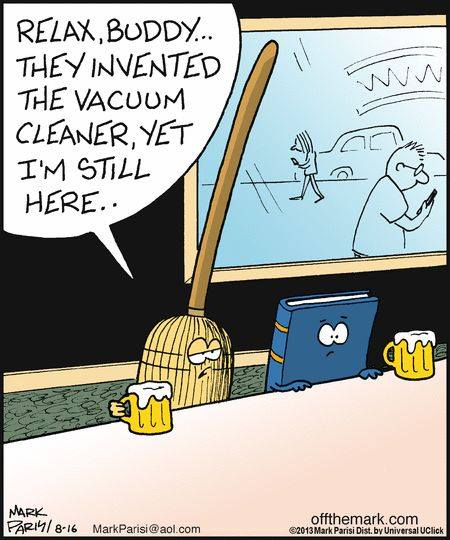
Parisi, M. https://www.offthemark.com/. 2013. Accessed 2 June 2024.
Toadstools and Fairy Dust.“The Secret Pizza Party (kids books read aloud) sound effects.”Youtube, uploaded by Toadstools and Fairy Dust, 3 Aug. 2022, https://www.youtube.com/watch?v=mk3frwTuFfs.
5 Comments
Anne Appenheimer
WOW!! What a great inquiry blog! I learned so much reading, and watching the various parts of your blog. Two things that really captured my imagination were creating the QR code which would reveal a student reading part of a book, and the use of green screen technology to create a scene from a book, or to entice others to keep reading to find the surprise in the book.
I agree with you that including the whole community in encouraging reading is great. It’s neat that parents were using the posted QR codes to listen to their kids reading. 🙂
It’s interesting that I have often seen Core French teachers use comic strips as a cumulative assignment in a unit, but I haven’t often seen the same to respond to something that has been read in the SLLC or in a literature class. Learning all the elements of a comic, and then applying that knowledge to a favourite book seems like a great idea.
Anne Appenheimer
Darcy
This is a strong post that leaves your reader with much to consider. I appreciate the way you have organized your post, the breadth of topics that you cover, as well as the practical strategies you share. I also appreciate the connections you are making to our course readings.
Dan M
Hi,
I really appreciated your tech suggestions. Children are interested in novelty, engagement with others and in producing authentic products and the QR code audio clip satisfies all those needs. Also, reading culture is a social construct, and when people have an interest in reading, that interest can often inspire others to read. The video book reviews are an interesting way to accomplish this.
Bethany Leng
Hi Elizabeth,
Thank you for sharing so many different ways to leverage technology to foster a reading culture. So many of your ideas were new to me and I hope to try out a few in the future! I particularly liked the way your school used QR codes with audio recordings of students reading excerpts from favourite books – what a wonderful way to encourage a reading culture that includes faculty, students and families! I would also love to try creating “mini-movie scenes” with green screen technology. Our school just got a green screen and students are very excited; I think this project would have high engagement!
I was intrigued to read about the app “Comic Life” in your post as well. A few months ago I read a Cult of Pedagogy article called “The Surprising Benefits of Student-Created Graphic Novels” by Shveta Miller. The article explains one teacher’s method of teaching students about the components of graphic novels and comic book features with the end goal of students creating their own graphic memoirs about a significant experience in their lives. The project was impactful in that the graphic novel form enabled students to express difficult topics in a friendly format while also strengthening student-teacher relationships. The students in the article created drawings for their graphic novels, but this app might be a nice tool to try for a similar project. Thank you so much for sharing!
Melanie
Your insights into how to integrate technology into fostering a reading culture are very practical. I love the idea of video book reviews and read-alouds. I would love to have students in my school begin to create their own read-aloud. My school is always struggling to get students out of the washrooms because that is where they film all their TikToks. I think having a green screen would pull many students into the LLC and provide the TL and teachers with opportunities to foster digital literacy and responsibility. Students could continue to make TikToks but they would need to, mostly, be focused on content from their classes.