Curriculum/Assessment
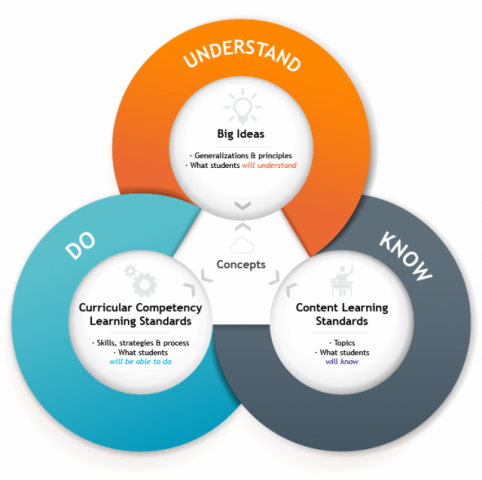
All areas of learning are based on a “Know-Do-Understand” model to support a concept-based competency-driven approach to learning.
Three elements, the Content (Know), Curricular Competencies (Do), and Big Ideas (Understand) all work together to support deeper learning.
Content (Know)
The content learning standards — the “Know” of the know-do-understand model of learning — detail the essential topics and knowledge at each grade level.
Curricular Competencies (Do)
The curricular competencies are the skills, strategies, and processes that students develop over time. They reflect the “do” in the know-do-understand model of learning. While curricular competencies are more subject-specific, they are connected to the core competencies.
Big Ideas (Understand)
The big ideas consist of generalizations and principles and the key concepts important in an area of learning. They reflect the “understand” component of the know-do-understand model of
British Columbia has a redesigned curriculum which means that we are also redesigning how we assess and report on student progress. According to the guidelines from the Ministry of Education, effective communication between home and school is central to student success. We will continue to communicate about student progress on an ongoing basis throughout the year. You will begin to notice some changes in format and language. There will be many opportunities to become familiar with these shifts.
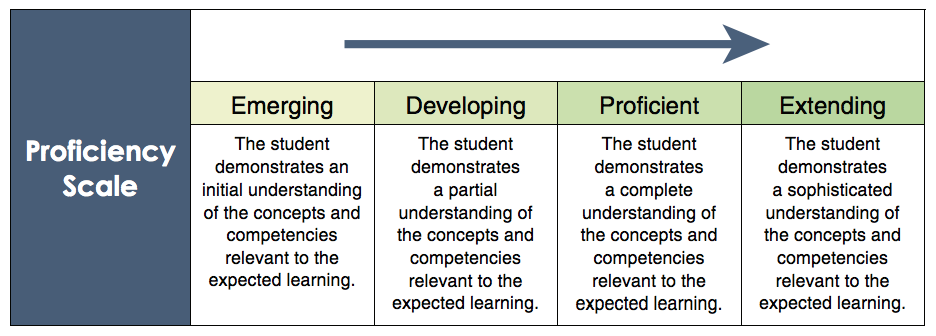
For example, School District approved Proficiency Scales will be used, along with other tools, to give specific, constructive feedback to students and help Teachers move learning forward.
For more information about British Columbia’s curriculum, please check out the Ministry of Education’s website here.
TERM 1 OVERVIEW
Throughout Term 1, students engaged in a rich, cross-curricular learning experience combining literacy, numeracy, design thinking, social studies inquiry, artistic expression, and hands-on scientific exploration. Learning emphasized the development of communication, critical and creative thinking, personal and social responsibility, problem-solving, and collaboration—all central BC competencies.
LANGUAGE ARTS (Reading, Writing, Speaking, Listening & Multimodal Storytelling)
Competencies & Capacities Developed
- Using reading strategies (inferencing, summarizing, predicting, questioning)
- Supporting ideas with reasoning and evidence
- Participating in peer feedback, group discussions, and democratic circles
- Expressing ideas clearly through spoken and visual storytelling
- Developing voice and identity through poetry and personal writing
- Strengthening narrative writing with a clear story arc, character development, and theme
- Creating multimodal narratives tailored to engage a specific audience
- Revising and editing through the writing process
Content & Learning Experiences
- Poetry forms: haiku, tanka, found poems, acrostics, A–Z identity poems, free verse
- Short-answer responses tied to articles, current events, and literature
- Figurative language, metaphor, and sensory detail
- Narrative Writing & Artifact Stories:
- Students created narratives using multiple formats—storyboards, picture books, comics, podcasts, stop-motion animations, and wordless Procreate films
- Emphasis on:
- Audience awareness
- A meaningful story arc (beginning–middle–end)
- Strong pacing and emotional flow
- A moral, theme, or insight to leave the audience thinking
- Students practiced transforming ideas across modes (e.g., turning a written story into a picture book or animation)
- Identity writing and reflective journals linked to activism themes and design work
MATHEMATICS (Number Sense, Computation, Geometry & Financial Literacy)
Competencies & Capacities
- Solving problems with strategies and reasoning
- Showing and explaining mathematical thinking
- Applying geometry and spatial thinking to design work
- Using math to support real-world decision-making
Content
- Place value to billions; decimals to thousandths; integer operations
- Multi-digit multiplication & long division
- Comparing, ordering, and converting fractions, decimals, and percents
- Financial literacy for Business Fair (costs, pricing, budgeting, profit/loss)
- Creating 3D forms using nets to support ADST prototypes and interactive designs
SCIENCE (Electricity, Circuits & Systems Thinking)
Competencies & Capacities
- Questioning, predicting, observing, and explaining
- Applying scientific concepts to real design challenges
- Understanding how systems interact (inputs, processes, outputs)
Content
- Electricity: conductors/insulators, static vs current electricity
- Series and parallel circuits using copper tape and LEDs
- Electromagnetism and energy transfer
- Micro:bit basics: inputs, outputs, loops, events, simple coding logic
- Chibitronics paper circuits: designing flat circuits for storytelling and interactive displays
- Using interactive technologies to enhance narrative and social justice design projects
SOCIAL STUDIES (Identity, Activism, Mapping Skills & Current Events)
Competencies & Capacities
- Interpreting multiple perspectives
- Building spatial awareness and analyzing visual data
- Evaluating fairness, equity, and community responsibility
- Understanding issues through storytelling, design, and critical discussion
Content
- Mapping skills: direction, landmarks, scale, global/regional perspective
- Current event analysis and responsible media literacy
- Exploring activism and imagining more hopeful futures
- Connecting narrative storytelling to social justice themes
ADST (Design Thinking, Digital Literacy & Interactive Technologies)
Competencies & Capacities
- Applying the Design Cycle (Understand → Define → Ideate → Prototype → Test → Make → Share → Reflect)
- Collaboration, creativity, and iterative improvement
- Evaluating user needs and audience experience
- Integrating digital and electronic tools into meaningful designs
Content
- Design sprints to build teamwork and innovation
- Developing interactive artifacts for social justice education
- Micro:bit programming (loops, conditionals, events, outputs)
- Paper circuits and Chibitronics to enhance physical designs
- Using geometry skills to create 3D structures and narrative displays
- Designing experiences that communicate a message or moral through multiple modes (visual, technological, written, auditory)
ART (Identity, Expression, Symbolism & Creative Processes)
Competencies & Capacities
- Choosing materials purposefully
- Expressing emotion, identity, and point of view
- Reflecting on creative process
- Working with symbolism and layered meaning
Content
- Chuck Close–inspired self-portraits
- Colour theory, mood, and emotional expression
- Kandinsky-inspired music–emotion abstract works
- Remembrance Day artworks (charcoal, watercolour, acrylic, collage)
- Symbolic representations integrated into activism and narrative designs
CAREER EDUCATION (Self-Awareness, Planning & Leadership)
Competencies & Capacities
- Goal setting and monitoring progress
- Building independence, organization, and self-regulation
- Understanding responsibilities and group roles
Content
- Business Fair planning (advertising, research, design, budgeting)
- Self-reflection and peer feedback routines
- Learning the purpose of values, team norms, and responsible citizenship
PHYSICAL & HEALTH EDUCATION (Teamwork, Coordination & Well-Being)
Competencies & Capacities
- Collaboration and communication
- Movement skills and coordination
- Personal and social responsibility
- Problem-solving during team activities
Content
- Volleyball and netball
- Cooperative and strategy-based games
- Self-regulation and community agreements
- Identity, values, and social problem-solving
FRENCH (Communication & Cultural Awareness)
Competencies & Capacities
- Using learned vocabulary in simple exchanges
- Listening and responding in context
- Building confidence with pronunciation
Content
- Greetings, conversational basics, numbers, classroom phrases
- French cultural connections through games, music, and simple dialogues