
Social Thinking Vocabulary — Chapter 3 of Social Thinking and Me
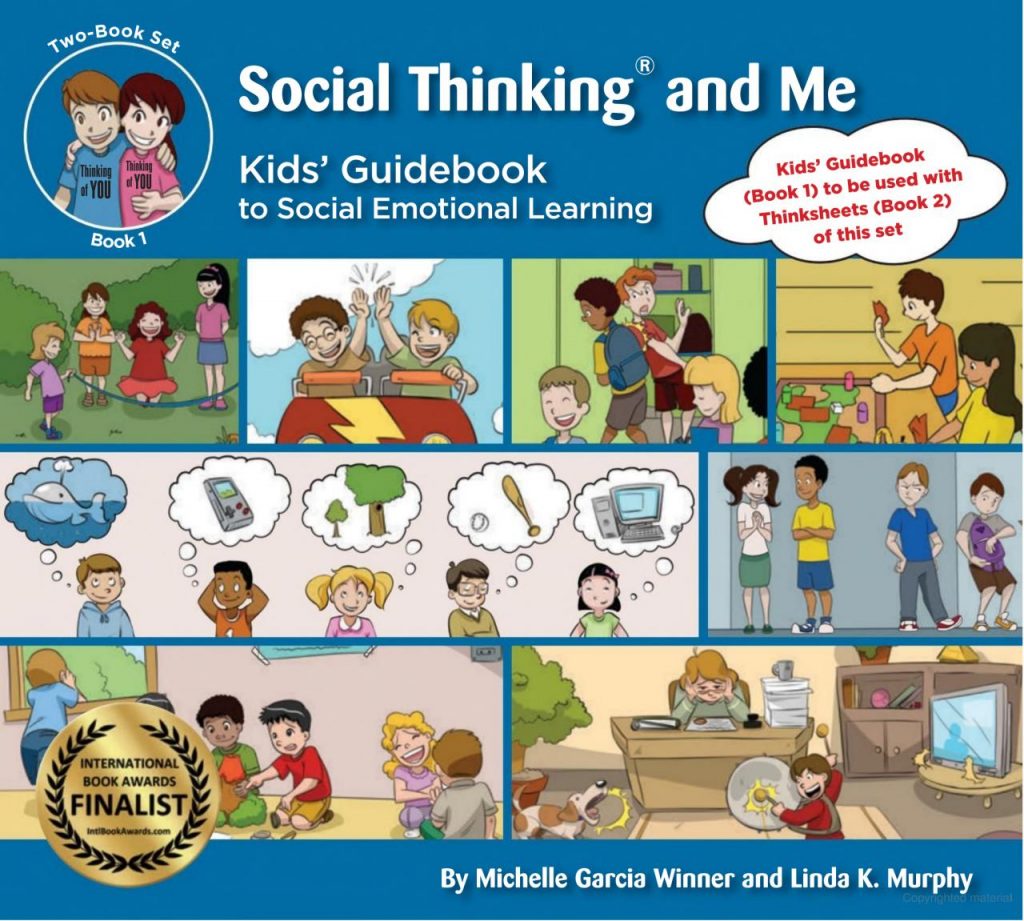
Hello Everyone!

We are continuing our work with Social Thinking, so here is a recap from Chapter 3 involving Social Thinking Vocabulary!

We can learn a variety of social thinking vocabulary to help us when we talk about social ideas with others. These words can help us be social detectives to figure out what’s happening in different places and with different people.

A summary of ideas we discussed, so you can talk about them at home:

  • I have thoughts about other people, and they have thoughts about me.
  • My thoughts are very much connected to my feelings.
  • I can think with my eyes to find social cues and clues in a situation. This means I look around and then use my brain to think about what I am observing.
  • Situations have hidden rules in them. Different situations have different hidden rules.
  • When I follow the hidden rules, I am using behaviour that helps people around me feel comfortable and calm.
  • When I am not following the hidden rules, my behaviour is unexpected. Others may feel uncomfortable around me.
  • Making smart guesses, especially about hidden rules, is one of the most important things I can learn to do as a social thinker.

Some questions to ask at home:

  • What are some new vocabulary words you can use to describe how you are feeling to one another?
  • What are the hidden rules in different situations you encounter as a family? For example, in your home, at a soccer match, at the grocery store, etc. Discuss while you are in the situation and make the rules explicit.
  • How is everyone using social cues to make good decisions about how to behave?

Thank you, and stay tuned for next chapter on Feelings from this week.

New Unit: Communication is the Key — End of February – End of March 2023

Hello Everyone!

This week we have started a new unit which will run from February –  March 2023.

Unit Title:
Communication is the KEY!

Concept:  POWER

Core Competency Focus:  Communication / Critical Thinking

Unit Focus Statement:
Being an educated citizen requires reflection and critical thinking about how we communication and receive information.

Areas of Inquiry:

  • The power of an educated citizen
  • Questioning and research skills
  • Forms of media and how they work (media literacy)
  • Fake news and social media safety (digital literacy)
  • Science Labs and communication results (primary vs secondary research)
  • Numbers in the News
  • Effective use of communication skills (presentations, writing, team activities, drama, visual arts)
  • The power of walking and mindfulness
  • Communication with others using basic French

Curricular Activities:

  • Using Media Smarts BC online program for examining role of media in our lives.
  • Understanding how media resources are organized; analyzing news broadcasts.
  • Creating our own broadcast news reports or newspaper articles.
  • Doing a variety of science experiments to practice the scientific method and primary research documentation.
  • Looking at wordless books and using visual imagery to create oral stories.
  • Continuing our independent project research
  • Creating watercolour pictures of the ABCs of Life and wire sculptures
  • Continuing work on proportionate reasoning, including ordering of fractions and decimals.
  • Looking at how math is used in the news and in advertisements.

Students will be investigating media, communications, and other topics above through some at-home explorations or questions in their planners. Please support them with discussion about these questions, as well as encouragement to set aside time at home to do these explorations.

***As students work on independent project, they really do need to set aside time at home to be doing research, and not just relying on time at school. It is also important they document their notes, with bibliography information, which we discussed in class. Visit a public library if you can!

Thank you for your support!

Ms. D