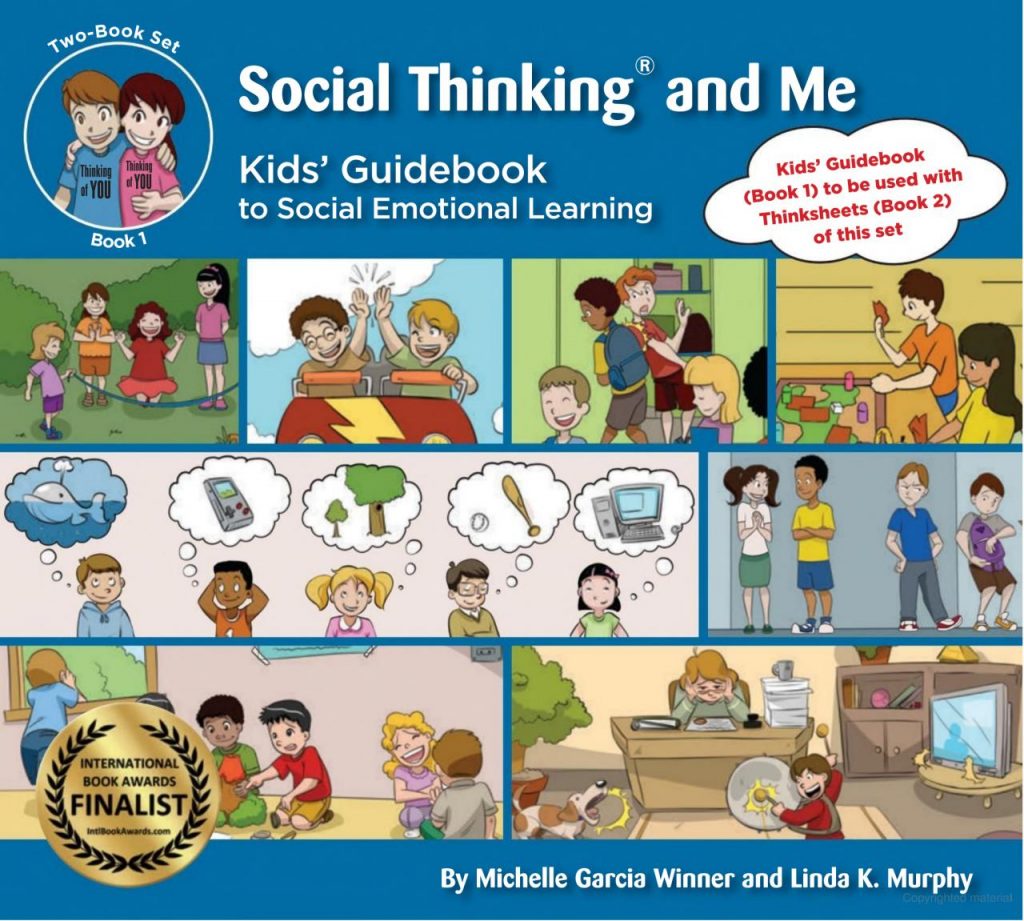
Social Thinking and Me Chapter 5: Thinking With Your Eyes


Before the break we went over Chapter 5 of Social Thinking and Me, called Thinking With Your Eyes. Here is the summary of key points covered so you can review at home, as well.


  1.  When I am with other people, it’s always important to think with my eyes. This means to look around where I am, notice the people I am with, and notice what’s going on.
  2.  There are many reasons to think with my eyes. Doing this can help me:
    1.  Be safe
    2.  Figure out what people are doing and why
    3.  Figure out what I am supposed to be doing in a situation
    4.  Let others know I am interested in them
    5.  Let others know I am paying attention
  3.  When I take time to think with my eyes in a situation, I am observing and learning to use social detective skills.
  4. There are all sorts of things I can do once I can think with my eyes. I can:
    1.  start a conversation with someone
    2.  make a guess about another person’s plan
    3.  figure out how someone is feeling
    4.  figure out what I should be doing or not doing!
  5. Thinking with my eyes is not something I do just once, and then I am done. It is a strategy I use throughout the day and anywhere I am: at school, at home, during recess and breaks, at the mall, or anywhere else I find myself.

Be observant, and then be a critical thinker, using the information you have observed to inform your actions!

Practice noticing what people are doing, feeling, and saying at home or when you are out with your family, to see what you can pick up about what to do or say next.


Websites to Use for Media/Digital Citizenship Discussions

We are going to take a look at these on the afternoon of Wednesday, March 29th, and you can continue looking at them at home as you would like! Some of the videos we already discussed in class can be found on the Ted Ed link.

Burnaby Schools Digital Citizenship Web Quest

Data Defenders Game, play on a laptop

Media Smarts Cyber Security Quiz

Media Smarts Reality Check Game

Media Smarts Food Advertising Coco Game

Common Sense Media Google Search Tips for Students

Common Sense Media Digital Passport

/https://www.easybib.com/guides/10-ways-to-spot-a-fake-news-article/

Burnaby Schools Learning Web Resources

Easy Bib Ten Ways to Spot a Fake News Articlei

Ted Ed Media and Journalism Resources

Common Sense Media What is your digital footprint?

Science Buddies Creating an MLA Bibiliography Guide

Easy Bib More complex MLA Bibliography Details – not required, but a challenge for some


E-Port: Visit from Journalist Theresa Lalonde, CBC

Hello Everyone,

If you were absent for the presentation today, please get notes from the journal of a friend, as Ms. Lalonde spoke today about a lot of great things we need to know as we move forward in the unit.

You should be able to answer the questions below even if you were not here if you check in with a person from class, as I wrote the notes on the board for everyone, and we went over it together after the presentation, as well. Let me know if you don’t understand a question or need help.

E-Port Title:  Visit from Journalist Theresa Lalonde, CBC

Questions:

What are the six things a journalist needs to consider as they decide the topic for a news report or article?

How is ethics a part of being a quality journalist?

When you write an article or news broadcast, what is something that will make your writing POP and get the attention of the reader or viewer?

What are the three main objectives of a journalist — what do they do?

What does civic engagement mean?

Why do people put fake news out there?

What does a journalist do to ensure they are not sued for libel?

What does a news producer do?

Independent Project Update: Continue Taking Notes, Primary Research


Hello Everyone!

As we head into Spring Break time, I want to take a moment to give an update on Independent Project.


What has already been done?

  • Students chose their topics and informed Ms. D
  • Ms. Ho put out requests to all District libraries for books related to topics
  • Ms. D went over the Jar of Inquiry and how to ask questions.
  • Students were told to begin with Form and Function type questions, and then to expand up into connection, perspective, and responsibility questions. Examples were provided in class and on the wonderings board.
  • Ms. D reviewed which are good websites to use, what information to take down to document resources, how to take notes in a T chart, and where to find things like copyright dates/publishers/about us on websites, etc.
  • Students began taking notes, whether in their journals by hand or online. No cutting and pasting, please! Notes in their own words. Use the T CHART format.
  • Dates for Independent Project deadlines were put in our planners, so students can refer to them.

What’s next?

  • Ask new questions. As you research, if something comes up that you are curious about, ask a new question!
  • Be sure to avoid commercial websites trying to sell you things, or websites where you can’t find an author and date. Ask Ms. D for help if needed.
  • We have been doing secondary research. Now is the time to get some primary research ideas.

What is Primary Research?

Primary research is doing the observing, documenting, analyzing, and making conclusions on your own instead of finding research already done by someone else. It can take many forms. Primary research is required for the project, and it needs to be documented with pictures or notes. Here are some ideas:

  • Interview with an expert on the topic. Before you do an interview, write down your questions and ask Ms. D to review them with you. Record the person’s answers, their name, and the date of the interview.
  • Do observations at a location, or of someone doing something related to your topic. It is a good idea to take both written observations, the dates you took the observations, and take some pictures to share later as part of your presentation.
  • Conduct a lab experiment. Use the scientific method to do a lab write up. Take pictures to document the process so you will have them for your presentation later. Write down the dates you conducted the experiment. We will be talking more about the scientific method this unit.
  • Build something. Document your design process with a draft drawing or plan, notes about how the process is going, and pictures so you have them for your presentation later. Record dates about when you did certain things in your notes.
  • Do something. Try something for the first time, document the experience, and take pictures so you have them for your presentation later. Record dates about when you did certain things in your notes.

Please try to think about a primary research item on your own. Ms. D can discuss with you immediately following Spring Break some ideas to help, but Spring Break is a great time to visit places!!

Making Our Own Commercials!


Hello Everyone!

We have been talking a lot about media literacy, with a focus on how advertisers and those who produce media use specific strategies, gimmicks, or tools to get our attention and sell products to us.

Using these tricks, I would like you to create a product and sell it to us through an in-person commercial in front of the class.


What are you making?

With a partner or individually you will make a product and then figure out a way to sell it to us in a short, live, memorized commercial in front of the class.

Partners were figured out today, March 3rd. If you were absent, I am going to ask you to work solo just for this time, so we can move forward. Also, please follow up with me to get a handout on the methods of advertising, which can help with this project.

If anyone is absent next week, we may need to have students work solo so things do get finished, so we will be flexible given many colds are going around right now.

The product needs to be an actual object, not a service you are trying to sell. The product doesn’t have to actually be a working thing, but rather a model of a new product you have invented. You can create the product using items from home, not necessarily from scratch.

The product may not be something that already exists, and it can’t involve cartoon or video game characters you already know. It can modify an existing common object. The example I gave in class is a frisbee that has been turned into a SUPER FRISBEE with a motor and flying ability. It does not have to “actually work.”

You will build a prototype of the product, and then one that is inside of packaging, so you can show them during the commercial.

You need to use specific strategies for advertising and packaging we have discussed (found in your journal or binder) to create a compelling commercial that makes us want to buy your product.

What are the steps?

  1. Brainstorm in your journal what your product will be.
  2.  Using the applied design process, you will draw a picture of your planned product first, so you have a plan in mind. Decide what materials would be needed and make a list in your journal. I would like to see this as part of the project, so I can see your planning process.
  3. Discuss what you will do to package or present the product so it is appealing. Think back to our notes about the cereal box or to other advertisements and packaging you have seen.
  4. Decide who your audience is? How will you appeal to that specific audience? Will your audience really want the product?
  5.  Build a prototype of the product along with its packaging.
  6. Give the product a name, and then decide what the slogan, jingle, or gimmick might be for selling it.
  7. Write a script for the commercial. If you are working with a partner, both of you need a speaking role. The commercial can be a direct sell to the audience, or it could be a skit. Think about other commercials you have seen for ideas. The script should be 1.5 minutes to 2 minutes in length. Short please!
  8. Use drama techniques to make this commercial interesting and engaging! Tone, emphasis, expression, volume, pace, pauses, as we will discuss more in class.
  9. What other things will you need to set the scene? Decide if you need a costume while you are doing the commercial. Do you need any props to help you create the setting where the product is used? Do you need anything in the background that can be hung up on the board?
  10. Practice presenting. You need to rehearse before doing it in front of the class. It would be helpful to memorize your lines, as reading a script for a commercial won’t be as effective.

What does Ms. D expect?

  • I can create a product by myself or with a partner using the applied design planning process.
  • I can work collaboratively with others if needed to produce a project.
  • I can present my ideas clearly to an audience using appropriate volume, enunciation, tone, expression, and pace.
  • I can create a commercial script that incorporates thinking about how advertisers sell things to their audience, including some specific wording from the resources Ms. D provided about how people sell products (see your binder.)
  • I can create a commercial and product that incorporates thinking about how advertisers use a brand name, slogan, packaging, and other gimmicks to sell a product.
  • I can explain who my audience was for the commercial, as well as how knowing my audience influenced my design choices for the product.

When is it due?  Friday, March 10th.

Have fun working on this project!

Social Thinking and Me: Chapter 4, We All Have Feelings


Hello Everyone,

I invite you to use the search bar on the front page of the blog and to search SOCIAL THINKING to find any past blog entries about the book Social Thinking and Me.

Also, each student has been taking notes on these chapters in their journals, so you can ask them to review their notes with you at home.


Here is the recap of Chapter 4, We All Have Feelings:

  • Everyone has feelings all the time, and there are many different types of feelings that people have.
  • It is really important to try and figure out your own feelings and then tell people what you are feeling if they ask. That helps others understand what you need.
  • As you get better at knowing your feelings and having vocabulary to describe them, then you can get better at making SMART GUESSES about how other people feel.
  • Our feelings come in different sizes. Sometimes people have big feelings, and sometimes people have small feelings. All feelings are important.
  • People may feel a certain way because of what other people are doing in the moment. They also may have a certain feeling because they remember what another person has done in the past, or notice what someone might do next.
  • It can be hard to figure out what someone is feeling at first. Your parents and teachers can help you do this when you are not sure.
  • As you spend time with other peers and adults, it is usually important to act in a way that makes them feel good. When others feel good around you, they are more likely to remember you as friendly.
  • Many times people don’t remember everything that you have DONE, but in the longer term, people will remember how you have made them FEEL.

In class, we took time to watch some animated shorts, without words, so we could identify the non-verbal messages people give to us about their feelings. This way we can practice knowing how people feel and how to interact with them. You can watch these at home by  just Googling PINGU, or SHAUN the SHEEP. They are also funny, so they are easy to watch at home with all ages.

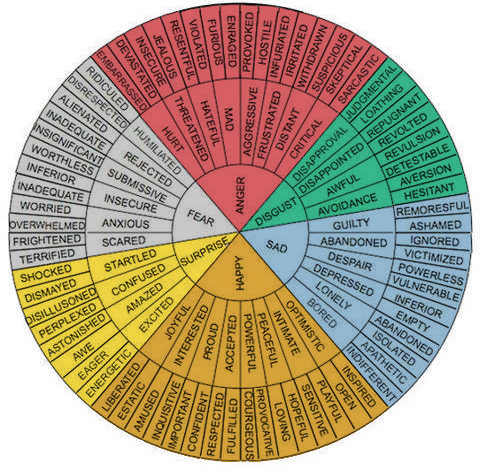
Another thing to begin doing is building emotional vocabulary, and talking about how this gives you greater nuance about how you are feeling. Here are some examples:

Instead of: GOOD — Use:  ecstatic, excited, positive, wonderful, spendid, marvelous

Instead of: FINE — Use:  content, calm, contemplative, pleased, comfortable, at ease

Instead of: ANGRY — Use: frustrated, annoyed, infuriated, resentful, flabbergasted

There are many lists of emotion words online to Google if you need more options!