With our first term coming to a close, and report cards just around the corner, I want to talk a bit about assessment and reporting. A quick Google of “proficiency scale bc” showed me these top searches:
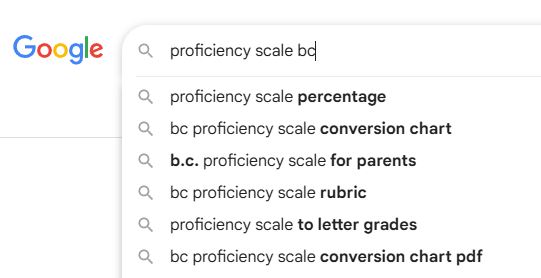
This tells me that the adults receiving the report cards are trying to understand the proficiency language in the way that they were assessed (or perceived to be assessed) when they were in school–whether that is percentages or letter grades. I get that: we try to understand things based on our own experiences. So let’s dive into what we’re really talking about in these report cards.
The proficiencies–Emerging, Developing, Proficient, and Extending–represent a snapshot of student learning at a certain point in time. It is not a “category” or a label for the child or their ability. We acknowledge that learning is a process in which we are active participants, and that stretches and struggles are sometimes a part of that process.
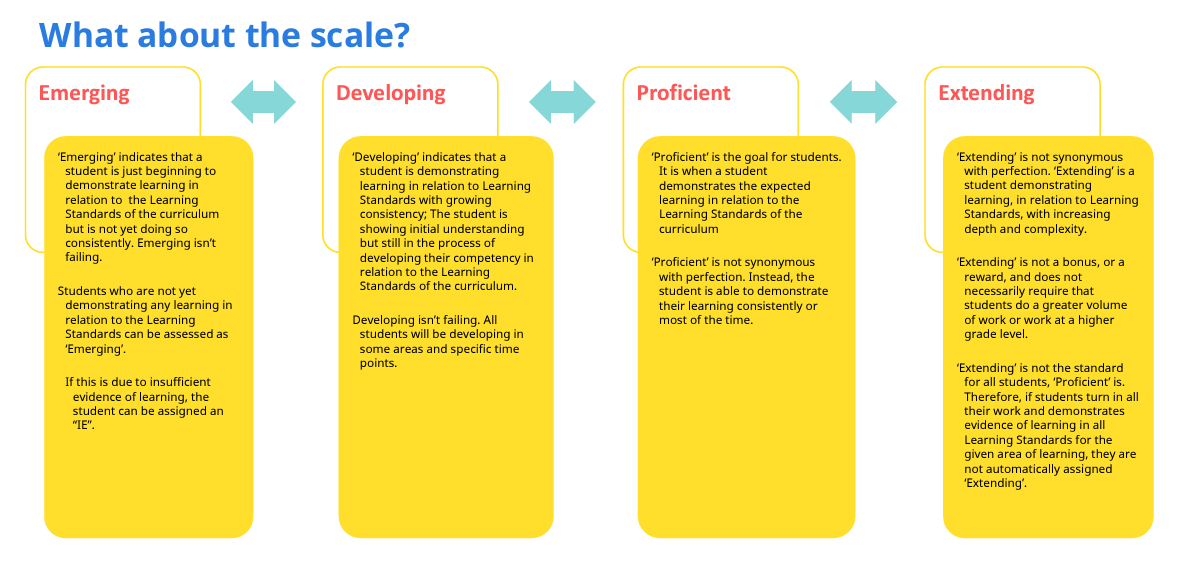
One of the major shifts in curriculum (that happened over ten years ago) was the creation of “curricular competencies” which are based in learning skills instead of content. So students’ abilities to question, communicate, think critically and creatively, and contribute to and participate in communities are foundational in their learning practice. So much so that these competencies are called the Core Competencies, upon which students self-assess themselves.
To be clear: the proficiencies do not align with letter grades. They do not align with percentages. Earlier in my career, even when we were using letter grades from grade 4-7, these still did not align with percentages (we had rubrics called “Quick Scales” which outlined the performance standards/expected content).
Here is a proficiency scale explanation in student-friendly language:
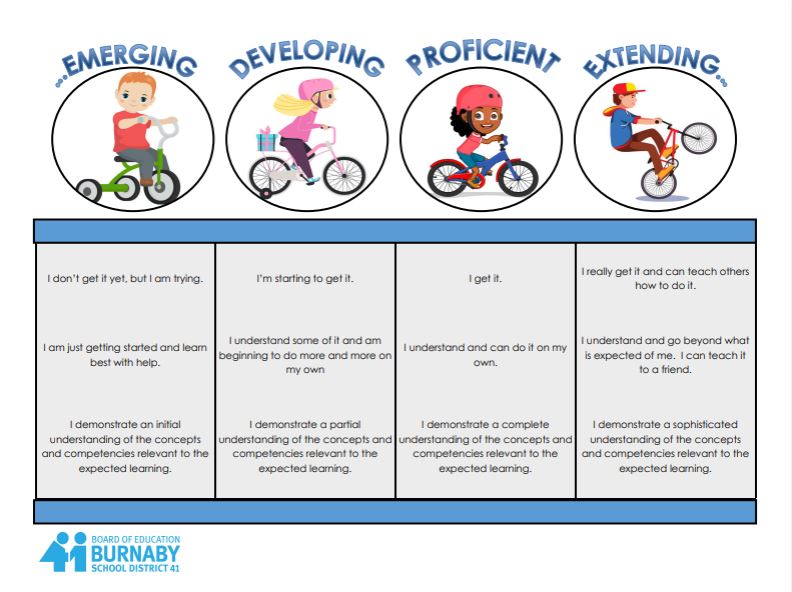
Especially for our grade 4 students, the first term is a time of big adjustments: more students in the class, different routines, and a shift in expectations (academic and personal independence) is a lot of adjust to! One of the things we’ve been working on this term is the idea of taking greater accountability for our actions as learners and members of a community. Finding commonalities and ways to get along with a  variety of people help us when conflict arises. We are learning to use our planners for our own reference to help us plan for and track due dates and events. Students are learning to receive feedback from peers and teachers, and to integrate it into their next assignments. I would say the “training wheels” are certainly still on, but we are also pushing students to stretch themselves and their burgeoning independence. When I have a room of 30ish students, we have a group plan where students are supported with routines and structures and are expected to leverage those tools with increasing independence, and make choices that contribute to their own learning.
Students in Division 7 are all somewhere along their proficiency journeys, and their attitudes and willingness to stretch themselves will pave their way to continued growth.