Welcome Back to an exciting year of learning!


Welcome Back to an exciting year of learning!
Comments Off on Welcome Back – Only 3 sleeps to go!
Posted in Uncategorized
Comments Off on Gene transfer – Plant style: Learn more about how plants use genes from other plants to enhance their growth
Posted in Uncategorized
Comments Off on Baby animals – first year on Earth, Learn more about patterns of inheritance
Posted in Uncategorized
DNA to RNA to mRNA to tRNA
Comments Off on Learn more about how to take note about Genetics: DNA to RNA (Transcription to translation)
Posted in Uncategorized
Comments Off on Learn more about mosquito genetics
Posted in Uncategorized
Comments Off on Learn more about how organic compounds can alter normal body chemistry
Posted in Uncategorized
Learn more about how to determine the maximum payload on a rocket:
If no outside forces act on a group of objects, the group’s combined momentum must stay constant over time. Imagine yourself standing on a skateboard with a basketball in your hands. If you throw the basketball in one direction, you and the skateboard will roll in the opposite direction to conserve momentum. The faster you throw the ball, the faster you roll backward.
Rockets work by expelling hot exhaust that acts in the same way as the basketball. The exhaust’s gas molecules don’t weigh much individually, but they exit the rocket’s nozzle very fast, giving them a lot of momentum. As a result, the rocket moves in the opposite direction of the exhaust with the same total oomph.
Comments Off on A beginners guide to launching a rocket – learn more
Posted in Uncategorized
Comments Off on What is so special about moon rocks – learn more…
Posted in Uncategorized
Have a Happy Summer Vacation:
Comments Off on Schools Out For Summer
Posted in Uncategorized
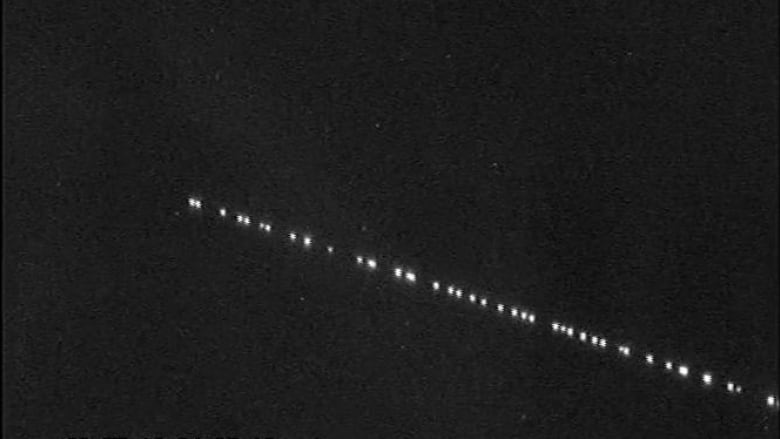
60 Starlinked satellites launched by Space X and photographed by Marco Langbrock.
Link to Marco Langbrocks Vimeo webpage
Link to Marco Langbrocks webpage
Link to Video of the launch of the 60 satellites
last week, SpaceX launched 60 satellites into space atop its Falcon 9 rocket. Less than a day later, astronomers captured their amazing trail of lights as they crossed the sky.
The 60 satellites launched by Space X are part of a project called Starlink. These new satellites will be part of a 12,000 satellite network whose goal is to provide much-improved internet access to every part of the world.
Marco Langbroek, an archeologist and spy satellite consultant based in the Netherlands, was stunned when he managed to record the satellites’ path using a low-light surveillance camera on May 24, 22 hours after their launch.
Astronomers are concerned about light pollution caused by the satellites.

How to see them
First, you need to understand about visual magnitude. Astronomers have come up with a way of measuring the brightness of objects in the night sky.
The brightness of celestial objects is on a scale that goes from the very brightest — the sun — to the dimmest. And the lower the number (negative values), the brighter the object.
As you can see by the chart above, the visual magnitude limitation for the human eye is an object with a magnitude of +6, and that’s in dark-sky locations, away from the pollution of city lights. Within a city, that drops to +3.
The brightness of the Starlink satellites over Toronto, for example, range from roughly +6 to +3, right on the visual limit in light-polluted skies.
So, if you want to see the satellites — which will have spread out a bit more by now — get to a dark-sky location, away from city lights. They won’t be as bright as in Langbroek’s video, since he captured them with a low-light camera.
Comments Off on Look up – look way up – look just a little bit up and you’ll see star linked satellites
Posted in Uncategorized