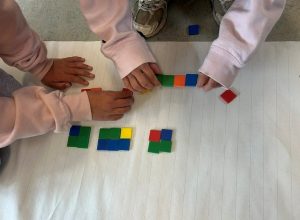
 Working in groups is a significant part of learning and decision making, in school and many career fields. This requires us to be active listeners and contributors in order to build understanding and work towards a common goal. Recently, it was time for a desk change. We’ve tried various arrangements throughout the year so far, but this time the students decided on how the desks should be organized.
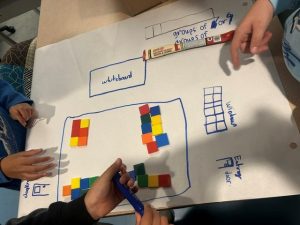 As a group, we brainstormed the various arrangements experienced in the past, and discussed the possible design constraints (shape and size of the room, number of desks, etc). Then students broke into small groups, where each group used tiles to design a possible layout. They had to discuss and negotiate different possibilities before having to reach a consensus on which design they thought best suited our classroom. They recorded their designs on large paper and outlined pros and cons for their design, considering issues around use of space, mobility, and “chatter.” Groups presented their ideas to the whole class, and then students voted.
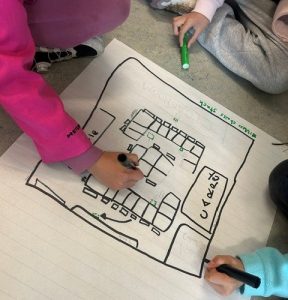 In the end, groups had varying degrees of success in terms of their ability to reach consensus and to express their ideas clearly. The layout that received the most votes was pods of 5 or 6. We agreed that we liked the table-type set-up as it was good for working in groups and for creating space to move throughout the room, but we also recognized that having a pod arrangement could contribute to more off-task talking. We also talked about the importance of self-regulation and making productive choices for ourselves and our learning, as well as our accountability to our classroom community.
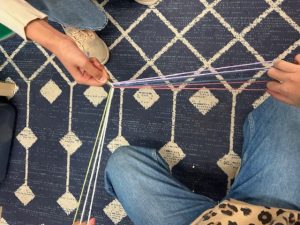 This term, Division 5 learned about the history of the Métis sash, or ceinture fléchée. We tried our hand (or rather our fingers) at a textile technique called “finger weaving,” used by Indigenous peoples all over North America. Here is a video about some of the history of the Métis sash.
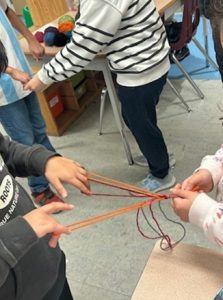 Students worked in pairs to help each other learn the process. One student held the yarn while the other did the weaving. Weaving was like learning some new dance steps, but once we understood the pattern we were flying!
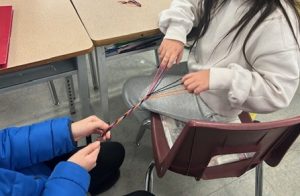 Students practiced their paragraph writing to accompany their weaving, to be displayed at the Student-Led Conferences. Their writing should give some information about who the Métis people are, and students’ experience with the process of learning and doing finger weaving.
 As students progress in their school experience, they are challenged to take on greater responsibility in a variety of areas: with their academics, their work-habits and responsibilities, and with their social-emotional regulation. As we build community in our classroom, it’s important that students are a part of deciding the tone and expectations of our shared learning space. Some of the questions we’ve explored in the first month of school have been: