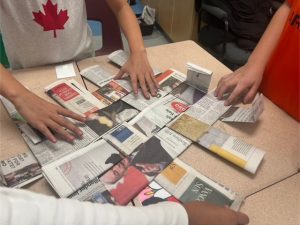
Students work together to fold newspaper strips to weave together into “situpon mats.”
Have you ever built a LEGO set with a friend, solved a tricky puzzle as a team, or helped someone understand a math problem? That’s what working and learning together is all about, and it’s one of the most powerful ways to grow, have fun, and succeed! In our classroom, collaboration is more than just a helpful skill; it’s a key part of how students grow, succeed, and enjoy learning. When learners work together, they build not only knowledge but also important life skills like communication, empathy, and teamwork.
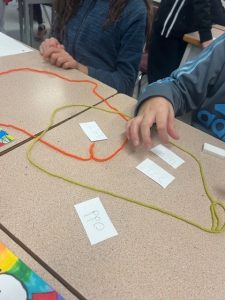
Exploring mathematical concepts: students discuss sorting attributes for 3- and 4-digit numbers, using strings for a Venn diagram
When we work together, we share ideas, help each other, and learn from one another. Everyone has different strengths: some people are great at writing, others at drawing, and some at solving problems. When we combine our talents, we can do incredible things. It’s also important that we learn to work with a variety of people in our classroom. While we won’t necessarily be “BFFs” with every person in our classroom, it’s important we take the time to get to know others and build bonds of trust and respect. Working together means listening, being kind, and respecting each other’s ideas. Even if we don’t always agree, we can learn to see things from different points of view. That’s how we grow as learners and as people.
Learning is often deeper and more meaningful when it happens through conversation. Students who explain their thinking to peers reinforce their own understanding, and those who listen gain new perspectives. This kind of shared learning helps build a classroom culture where curiosity and questions are welcomed.
All of these “soft skills” are more of what I would call foundational skills. In the BC curriculum, these are referred to as “Core Competencies,” which students self-assess for each term. You can read more about Core Competencies here.
Here are some tips for fostering communication, community, and curiosity at home:
1. Ask Open-Ended Questions
Instead of yes/no questions, try questions that invite children to explain their thinking and reflect on their learning.
- “What was something new you discovered today?”
- “Can you teach me how you did that?”
2. Encourage “Think Alouds”
When your child is working on homework or solving a problem, encourage them to talk through their thought process. This helps them organize their ideas and often leads to deeper understanding.
3. Celebrate Curiosity
If your child asks a question — even a tricky one — explore the answer together. Look things up, talk about possibilities, and show that asking questions is a great way to learn. Help them find the answers instead of just giving them the answers.
4. Share Your Own Thinking
Model how you solve problems or make decisions. For example, while cooking, you might say, “I’m doubling this recipe, so I need to figure out how much flour to use.” This shows that thinking and learning happen all the time.
5. Create Space for Discussion
Set aside time during meals or bedtime for relaxed conversations about the day. These moments are perfect for sharing ideas, asking questions, and connecting through learning.
Leave a Reply