
This week, you will be exploring spatial and visual problems related to painting cubes, like Rubik’s Cubes. Visual-spatial intelligence is intelligence associated with the ability to easily perceive visual trends, conceptualize shapes and objects, and interpret images and diagrams. This type of intelligence is commonly found among those who excel as architects, artists, and engineering.
The following video shows the fastest robot according to Guinness World Records at solving Rubik’s Cubes. What types of programming algorithms do you think this robot would need to solve the Rubik’s Cube? Do you think you could do it faster?
Visual Patterns
Pattern 1
Take a look at the three figures. Notice the following:
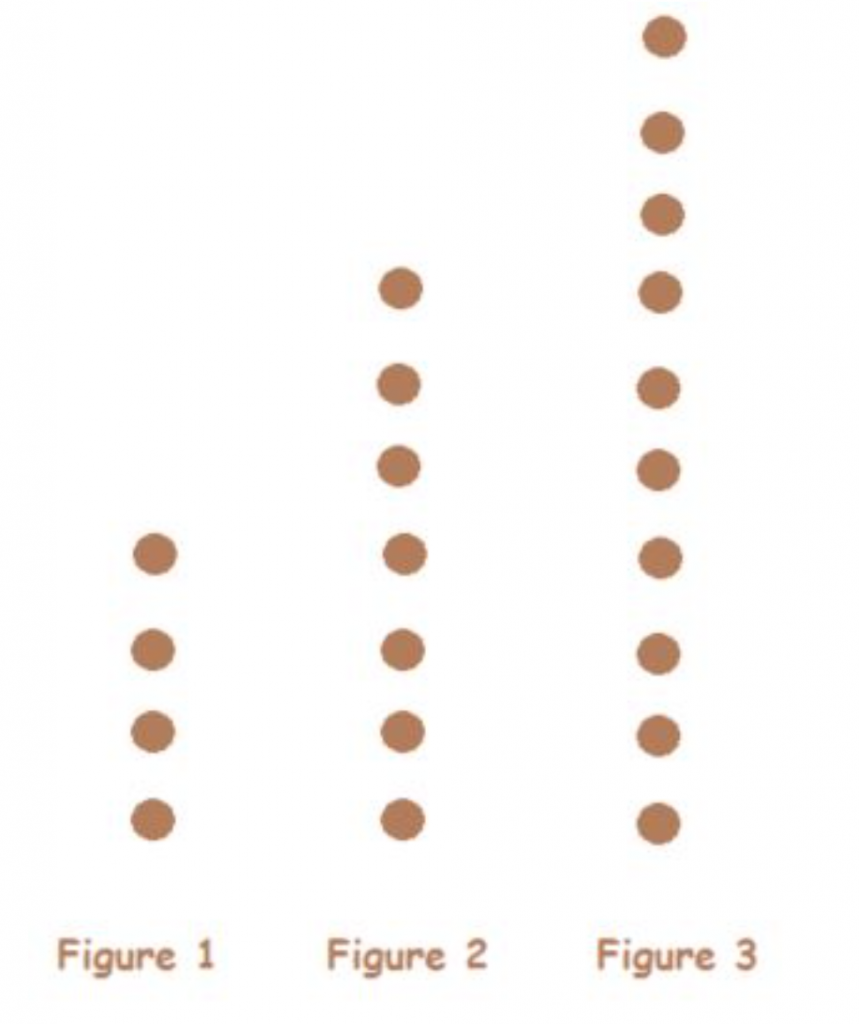
Figure 1 has 4 dots
Figure 2 has 7 dots
Figure 3 has 10 dots
How many dots would figure 4 have? Figure 5? Figure 11? Each figure has 3 dots more than the one before it.
Sometimes it’s easier to see the pattern if you make a chart. It’s easy to see the number of dots figures 4 and 5 will have.
| Figure # | 1 | 2 | 3 | 4 | 5 |
| Number of Dots | 4 | 7 | 10 | 13 | 15 |
This is easy as long as we don’t need to know how many dots figure 125 or 632 would have.
But could you determine this by using a formula? Can you see a relationship between the figure number and the number of dots? What mathematical operation could you do to the number 1 to get 4? To the number 2 to get 7?
Take a moment to think about this.
Try to come up with your own formula and solutions for figures 125 and 632 before you continue scrolling.
Solution
You may notice that if you multiply the figure number by 3 and add 1 you get the number of dots.
1 x 3 + 1 = 4
2 x 3 + 1 = 7
3 x 3 + 1 = 10
4 x 3 + 1 = 13
etc.
So whatever the figure number is, multiply it by 3 and add 1 to get the number of dots.
Figure number 125 would have:
125 x 3 + 1 = 376
Figure number 632 would have:
632 x 3 + 1 = 1897
By determining the formula, you don’t have to write out the table to 632 columns!
Pattern 2
Here’s another pattern:
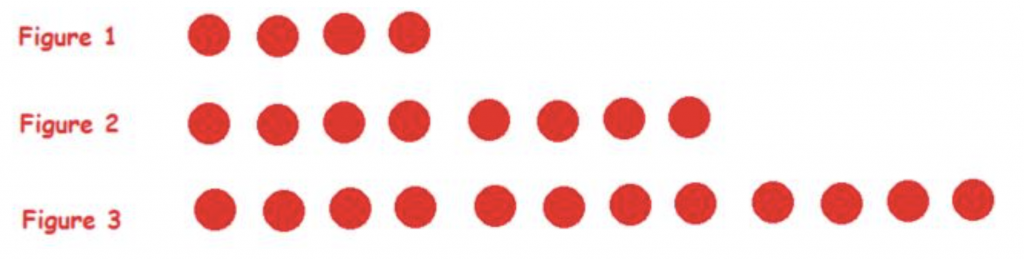
- Figure 1 has 4 red dots
- Figure 2 has 8 red dots
- Figure 3 has 12 red dots
In each figure, the number of red dots is 4 times the figure number.
Figure 1 has (1 x 4) 4 dots, figure 2 has (2 x 4) 8 dots, etc.
Let’s make it into a chart:
| Figure # | 1 | 2 | 3 | 4 |
| Red Dots | 4 | 8 | 12 | ?? |
Can you see a formula? Can you figure out how many red dots figure 4 would have? What about figure 10? 20? It’s easy when you have the formula.
Take a moment to see if you can determine the formula before scrolling down for the answer.
Solution
The rule or formula here is to multiply the figure number by 4.
Therefore 4f = dots
Number Patterns
Finding the relationships in a set of numbers can help you to continue the pattern. Can you see what the next two numbers in this pattern will be?
8, 13, 18, 23, ____, _____
By looking at the relationships between the numbers you can see that to find the next number you’ll need to add 5; so the next two numbers will be 28 and 33.
What do you think the 5th number will be in this pattern?
60, 50, 40, 30, ____
The rule is to subtract 10 from each number.
THE KEY to determining the patterns is to find the relationships between the numbers. In these cases, you can determine the relationship by looking at successive numbers.
Let’s Practice
Complete the chart below, formulate a rule for the pattern, and determine the number of cubes figure 6 would have.
| Figure # | 1 | 2 | 3 | 4 | 5 |
| Blue Cubes | 3 | 4 | 5 | ?? | ?? |
| Yellow Cubes | 1 | 2 | 3 | ?? | ?? |
| Total Cubes | 4 | 6 | 8 | ?? | ?? |
Complete the table and when you are done, scroll down for the answer.
Solution
You can see that both the blue and yellow cubes increase by one each time and the total number of cubes increases by 2.
| Figure # | 1 | 2 | 3 | 4 | 5 |
| Blue Cubes | 3 | 4 | 5 | 6 | 7 |
| Yellow Cubes | 1 | 2 | 3 | 4 | 5 |
| Total Cubes | 4 | 6 | 8 | 10 | 12 |
The rule to determine the number of blue cubes is to take the figure number and add 2. So figure number 1 has 3 blue cubes (1 + 2) and figure number 6 would have 8 blue cubes (8 + 2).
The number of yellow cubes in each figure is the same as the figure number so figure number 1 has 1 yellow cube and figure number 6 would have 6 yellow cubes. The rule is that the figure number is equal to the number of yellow cubes.
The rule to determine the total cubes is to add the two rules together.
Figure number + 2 + figure number = total cubes
So figure number 6 would have:
6 + 2 + 6 = 14 total cubes
This could also be stated as (2 x figure number) + 2