Human Body Corporation Project

Division 5 students have been doing a great job investigating the human body through hands-on body stations, reading, watching videos, and class discussion. We have lots of great questions already about how the system of the body works!

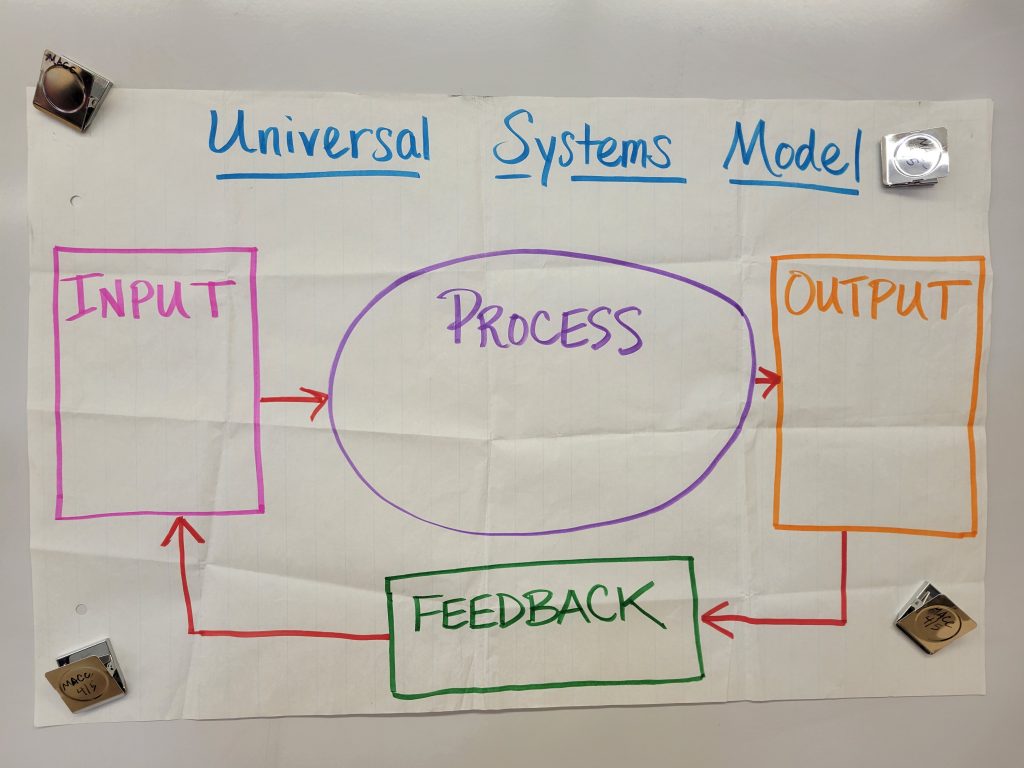
We have been discussing the Universal Systems Model and how every system has an INPUT, PROCESS, OUTPUT, and FEEDBACK. We are identifying the many INPUTS our human body system needs to work correctly, such as sleep, exercise, good nutrition, and balance. We will continue these discussions over the next few weeks.

Part of taking care of the human body SYSTEM is making good decisions. We are talking about what we have control over in terms of personal choices that will help us grow, learn, and feel better each day. If you want to make a good decision, how do you do it? Maybe you have to consider the DATA, to find out if the input into the system is a good one. Or, perhaps you need to find out if a certain OUTPUT/OUTCOME is more likely based on your investigations. This is all connected to our math discussions about data and probability!

If you missed these recent videos shown in class, here you go!

Real Science Circulatory and Respiratory System

Ted Ed How Does the Heart Pump Blood

YouTube The Blood Flow Song

Ted Ed How the Digestive System Works

There are more in the Articles of Interest section of the blog and on Kidshealth.org.

Now, we will work on the Human Body Corporation!

In class we will work on practicing effective paragraphs, as well as why and how you would write a business letter. We will write samples together to prepare for doing our first project with a rubric — Human Body Corporation!

Each person will choose an organ to represent in the human body.

As a body organ, we will pretend you are an employee of the Human Body Corporation.

Due to recent cost increases, the Human Body Corporation needs to fire workers.  Uh oh! You might lose your job! You need to write a letter to the Human Body Corporation explaining why you are very important to the human body and should not be fired!

In your letter, you need to describe to the Corporation the following characteristics of your organ:

  • Tell what the name of your organ is and where you are located
  • Identify what systems of the body you work with
  • Describe how you work with these systems
  • List the other organs that work with you in your system
  • Describe your main functions or jobs as a Human Body organ
  • Tell the Corporation how you perform those functions or jobs
  • Tell the Corporation why you are important and why they should not fire you
  • Explain what might happen to the Human Body Corporation if they fired you

Do some further research on your organ. In your JOURNAL, make a new page called “Human Body Corporation Notes.” Write down a bullet point from the list above, and then take some notes in your own words from what you read online or in the books you can find in class.

Next step, you will draft your letter. You will need to use a proper BUSINESS LETTER format to write your letter.

Edit the letter carefully and then have a peer do an edit. Do not let the peer fix the mistakes – that is your job. I am looking for careful use of capitalization and punctuation, complete sentences, and sentences that have a variety of starts to them (instead of all I am this, or I do that.) Try to begin using conjunctions to connect ideas (and, but, however, or), and transition words and phrases (furthermore, next, in this case, etc.)

Then, finally, you will type a finished final draft to turn in to Ms. D, and you will read your letter to the Human Body Corporation (the rest of the class.)

Work on this project will mostly be done in class.

You may use the book or online resources in the classroom to find out information that supports your position AND include this evidence in your letter.

Remember, we showed you a business letter sample in class, and it had specific parts to include:

  1.  Addresses and dates  (Make up the address — use something funny)
  2.  An opening/greeting with a colon
  3.  No indents
  4.  A first paragraph introducing yourself, who you are, and what you are asking of the Human Body Corporation
  5.  A second paragraph really pleading your case about why you are important. If you need two paragraphs for this, it is okay. Remember to avoid big blobs of text. The Human Body Corporation is busy and likes to read its information in quick, easy-to-digest parts.
  6.  A final paragraph summing up what you have said and thanking the Human Body Corporation for being gracious about reading your letter.
  7.  A closing (Respectfully, With respect, Sincerely)
  8.  A signature

The Human Body Corporation looks forward to hearing your case!

Ms. D

Managing School Work at Home – Some Tips from Ms. D


Hello Parents!

Before I post details of our first project together, I would like to talk about how and when projects can be worked on at home.

You may have noticed blue binders and journals are not going home every day. They eventually will go home, but I really want students to focus on using their time well in class and on being independent with their work.

I want to see what they can do on their own during the given class time.

If students need catch up time, then that is why I have asked everyone to make sure there are 30-40 minutes set aside for catch up at home.

So, before I hand out the first project, here are some tips to follow:

  • Students are to work on assignments and projects mainly at school.
  • If they do a project ALL at home on the first night it is assigned, this leads to boredom in school, as time will be given to work on the project. As a result of boredom, unexpected behaviours that impact our classroom community can occur. It can also lead to you pulling your hair out at home as they do the entire assignment, as they will be over tired. It is the end of the day — time to rest, not time to do a whole project.
  • If they need catch up time for a project beyond class time, or they are doing some extra research at home, we will put this in their planner so you know.
  • Limit catch up time at home to the 30-40 minutes you have put aside in the schedule for each night.
  • Set a visual timer if necessary to limit the time, as many students at this age do not have a good sense of time and need to get a sense of how long they are spending on things.
  • The only reason to use more than 40 minutes would be if your child was absent, is not using their class time well, or is having fun researching something on their own. If they want to look something up, that’s great! BUT, I encourage you to limit the total time on a computer to no more than one hour because otherwise it can become obsessive (or they end up taking breaks playing games….)
  • When the time is up, ask them to pack their things in a backpack. Check to make sure they have everything they brought home – planner, journal, binder. They need help sometimes doing this as they begin the intermediate grades. The time spent on building a routine now will help them be more independent later on.
  • For students who want to work longer, as they often do, ask them what would Ms. D say about that? What do the body systems need as INPUTS to work correctly? SLEEP, REST, BALANCE, and PLAY! Have a calm discussion about what they know about how these things are important to the body.
  • When possible, encourage your child to do calm things the hour before bed. Avoid technology, listen to music, play with lego or hands-on things just for fun, have a conversation together, or read something quietly.
  • If they are worried about the next day, try some breathing activities together, or read them something funny to distract them. This can lead to better sleep and better learning for your child the next day.
  • If your child has a question about their work while at home, or had a conflict with another student in a group project that is troubling them, try not to engage in answering it, fixing it, or writing me an email explaining the whole situation. Try as hard as you can not to react too much. Say, “I hear you, that is a great question. Maybe ask Ms. D tomorrow about that.” Or, “I hear you, that sounds frustrating. I know you can be a good communicator to Ms. D tomorrow to explain what you need. Ms. D helps people in class, right? I bet she will also help you with this.” Be calm, acknowledge the emotion they are feeling, and then offer the solution to ask the question tomorrow. Then continue your bedtime routine.
  • Encourage your child to do their own communicating and fixing as much as you can, even though it is sometimes out of their comfort zone. Doing the work in class allows for them to seek me out as a guide for their questions, rather than perseverating on things at home in unhealthy ways.
  • Of course offer help to your child if they ask you questions about spelling, grammar, or facts. But, encourage them to do the looking for information rather than you giving the information to them.
  • Encourage them to do the writing and editing themselves. Avoid sitting down and editing the whole writing with them. Say instead, “I encourage you to go back and edit for capitalization and punctuation.” Or, “Here is a dictionary or technology tool to check spelling if you need it.” Get them to fix their own writing — try not to fix it for them or they will come to rely on that help and not really process their own writing errors.
  • When they finish a project or assignment, they will get feedback. Encourage then to self-reflect on how it went. Ask, “So, what do you think went well?” and then, “What do you think is one thing you would really like to work on for the next project?” You will see these reflections in e-port entries and on the rubrics marking their projects. Have a calm discussion and get them to do most of the talking. 🙂

No, the process won’t be smooth. It is normal for grade four and five students to have difficulty with organization and time management — even more normal for advanced learners to have difficulty with this!

As parents and teachers, all we can do is just keep gently guiding them forward. Try to stay calm, because none of it is worth the stress. Remember, in these early grades we are practicing these skills. Marks at this grade level are not going to be visible on the transcript they submit to university.

As someone who has seen all of this as a teacher for 22 years, and as the parent of two older children, it is very likely our efforts as a team will pay off in higher grades and help them have the tools to manage school and activities in healthy ways.

I wish you all a healthy year as we manage the balance of school and home life. 🙂

Thanks,

Ms. D

E-Portfolios and How They Work

Hello!

Soon, each student will be given their e-portfolio!

What is an e-portfolio?

It is like a mini version of the blog you are reading, created using WordPress. On the e-portfolio, students will post pictures, reflections, and answers to assessment questions, which will allow us all to give them feedback about how they are doing.

Who can access the e-portfolio?

The e-portfolio access point is on the blog, but requires a password, which I will send in e-mail to everyone. Each student’s e-port is only accessible by the teacher, student, principal, and parents. It is not public, nor is it accessible by other students. Parents use their own access user ID and password, and students are advised to keep their passwords private.

How often will students put something on the e-portfolio?

Typically there will be something once per week, but it depends on what we are doing and whether we have a long or short week.

Where do we find the questions for e-portfolios?

Students will find the questions on this blog. That way if they are absent, they can still find them.

When are e-portfolios due?

I tell students to try and finish the e-portfolio entry by one week from the time it is assigned.

When I go to assess entries, if I find one is not done, I will go ahead and publish it in its incomplete version, so parents and the student can see there is one not finished. If a student were to have many entries not complete, I will also email home. E-portfolios are an important part of assessment, so please make sure they do get done.

Can a student get help for answering e-portfolio questions?

Students can use their journals and blue binders to answer questions. They are not to use the internet, nor are they to receive any help from parents at home. Parents CAN answer questions about spelling or grammar, of course, but they shouldn’t be writing the answers by dictation for students or editing the material for them prior to posting. Both parents and teacher can give feedback, though, in the comments, after the entry is posted, about how they can improve either their content or communication skills.

Students are not to cut and paste from websites, nor use any other digital tools, to create or to copy content.

The questions are often personal in nature, so I am really asking students to do their own thinking about the connections they are making with the curriculum.

I also collect writing samples in class so I can see how their writing in person matches with what they are producing online, so it is best if they do not cut and paste or get writing help.

How does a student get feedback?

Both teacher and parents can give feedback by making a comment directly on the e-portfolio. It is important it is STRENGTH-BASED FEEDBACK. Start with what you notice is done well, and then choose one to two things maximum to comment on that they could develop for next time. This may include things like language arts writing skills or organization of their response.

When the teacher provides feedback, you will see a reference to the PROFICIENCY SCALE.

Take into mind e-portfolio entries in our class function for assesment of multiple things at the same time, given the integrated nature of subjects. For example, on a single entry, I may be able to look at understandings of socials and science, while also looking at language arts sentence structure.

How should answers be given?

Answers need to be in complete sentences or paragraphs as appropriate. If it asks for a list, then give a list, otherwise, please use complete sentences.

How long should answers be?

Answers need to answer the question. But, more writing does not equal higher quality. I will read whatever they post, but they do not need to write a novel! They also need to be aware of their time. Set aside the 30-40 minutes after school each day to catch up, and use the time wisely when given in class. Focus on giving the answer, not on writing a long story. I will provide examples in class of what I mean, so they can see what I mean before we start.

When will this begin?

Soon! I plan to get e-portfolios out to students by end of week, and then parents will receive their passwords at some point over the next two weeks, as I have to go in to each of the 24 e-ports individually to set that up, and it takes time.

Stay tuned for more information!

Ms. D


Healthy Systems Mean Choosing Healthy Inputs!

Hello Everyone!

As part of this unit, we have been unpacking the deeper concept of SYSTEMS. To do this, we are using the Universal Systems Model.

We identified what each part of the model means, and we looked at a variety of systems, such as our solar system, the government system, and the food delivery system (like a grocery store).

It has also been helpful when looking at the system involved in creating a classroom community, such as Division 5. If the OUTPUT we want is a healthy classroom community, friendships, and positive feelings every day, then what kinds of INPUTS do we all need to commit to providing to our community? What do we need? Some things we have been highlighting as important as INPUTS are:

  • Having awareness about personal space
  • Communicating our needs, and doing it in kind, mature ways
  • Following the expected behaviours
  • Working with the GROUP PLAN rather than just our SOLO (me, me, me) PLAN
  • Contributing to discussion, projects, and classroom clean up
  • Being aware of school rules for safety of everyone
  • Using the H.E.A.R. strategy to truly listen with our bodies and minds
  • Taking turns to talk and not being an “interrupting chicken”
  • Using our words rather than yelling or using physical ways to communicate

Of course, our main focus this unit is learning about human body systems. What personal choices do we make every day that impact and are INPUTS to the SYSTEM of the human body? How will we know if we have made the correct personal choices? Which choices do we have control over, and which ones do we not have control over? How do we give FEEDBACK to others when we aren’t getting what we need? How does the body give us FEEDBACK to let us know we need to change our INPUTS?

We are emphasizing these healthy INPUTS as we go along:

  • Managing ourselves – our time, our supplies, our space
  • Cultivating healthy relationships with classmates
  • Choosing healthy foods
  • Getting enough sleep (students this age need 10-12 hours a night)
  • Having balance between our activities, academics, and down time such as play
  • Paying attention to appropriate hygiene
  • Wearing the correct clothing to protect ourselves from the elements
  • Finding ways to calm ourselves and understanding how this helps (arts, mindfulness techniques, play time, fresh air, being outside)
  • Getting exercise in a variety of ways (dance, running, yoga)
  • Making goals and taking time to reflect on them

I look forward to talking with Division 5 more about this in the coming weeks!

Ms. D

Recalibrate & Social Thinking: Some new tips!

Hello Everyone,

As we are getting to know one another, we are working on tools and strategies that help us get along well together.

Expected and Unexpected Behaviour:

Expected behaviour is what one would generally expect in a given situation. For example, what kind of behaviour is generally okay at school? In the classroom? At the dinner table? In a library?

Unexpected behaviour is something we do that falls outside of the general norms of behaviour. For example, a person talking during the movie in a movie theatre full of people watching the film is unexpected. What happens when we do unexpected behaviour? Generally, people don’t like it, or they can feel stress.

The reality is, when we do expected behaviours in group situations, it makes the group feel less stressed, and people get along with us better! This doesn’t mean we can’t be ourselves, or that we can’t make mistakes sometimes. It just means when we follow certain norms in group situations, the SYSTEM of getting along just works better.

Examples: Not yelling when you don’t get your way, using your words to communicate needs, waiting your turn in line ups, not touching one another and respecting personal space.

We did some skits together as a group to practice recognizing and naming expected and unexpected behaviours so we can become more aware of them.

Don’t Hug Doug!

We read a very funny book called Don’t Hug Doug about being aware of everyone’s personal space. We went over many situations in which we do not need to be physical. Give one another space when working together in groups. Don’t get aggressive during tag games. Don’t ever hug someone or put your hand on someone without permission — give a high five instead of a hug if the person is okay with that!

Five Ways to Respectfully Disagree:

As part of our human body studies, we are using KidsHealth.org to look at all types of information about body systems and how they work. On this website are also helpful articles about social-emotional learning and communication strategies. One of them is Five Ways to Respectfully Disagree, which I went over with the students today.

Students have Free Choice Time twice a week at the end of the day (Wednesday and Friday), which is directly connected to our Physical & Health Education, Career Education, and ADST curricular competencies, as well as the core competencies. It gives an opportunity for students to practice, under supervision, social thinking strategies. It is also a great time to catch up on work, read, build, and practice creative and critical thinking skills.

I noticed during Free Choice on Friday how we are still working on how to play games respectfully and how to use our words, so we don’t end in conflicts or misunderstandings. So, we went over these tips. When you disagree with someone, or you don’t see eye to eye about anything — particularly rules of a game — here are some things to do:

  1.  Don’t make it personal. If you get upset, remember you are mad about the idea or the situation, not the person.
  2.  Avoid putting down people’s ideas, beliefs, or personal characteristics. Don’t yell, scream, or taunt the person. Take a breath. Stay calm. State what is making you feel bad. Use the phrase: WHEN YOU ________, I FEEL __________.  Make it about how you are feeling rather than attacking the other person.
  3.  Use I statements to communicate how you feel, what you think, and what you want or need. Try to do it calmly after taking a breath. Using YOU statements can sound attacking and argumentative.
  4.  Listen to the other point of view. Being a good listener lets the other person know you respect their right to another perspective even if you don’t agree. Try to use the HEAR method. Use body language that shows you are listening. Be quiet and give the other person a chance to say their part.
  5.  STAY CALM. If things get heated, things are not going to get resolved. Take a breath. If you can’t stay calm, walk away for a bit or get some help. Remember on the playground to use the STOP, WALK, TALK method for avoiding more serious conflict.

Okay, let’s work on these things at school and at home!

Thank you,

Ms. D

First Unit of 2023-24! — SYSTEMS

Hello Everyone!

Now posted on our classroom wall is our first unit about the concept of SYSTEMS!

As explained in the handout you received on the first day, I organize the year into longer units, which each focus on a CONCEPT. Our first one is SYSTEMS. Each time we begin a new unit, I will post here the unit focus statement and areas of inquiry, as well as the core and curricular competency areas of focus for us.

So, let’s get started!

Unit Focus Statement:

Our personal choices play a role in how the interconnected system of the human body works.

Concept Guiding the Unit:  SYSTEMS

Core Competency Focus Areas: Personal Awareness & Critical Thinking

Areas of Inquiry:

  • The nature of systems and how we participate in them
  • The systems of the body and how they work together
  • Diseases and how the body defends against them
  • Choices and personal awareness that contribute to our overall well being
  • How we gather, organize, and interpret data to make healthy choices
  • Indigenous and world perspectives on health
  • How art and mindfulness practices are related to mental and physical wellness
  • French vocabulary and basic expressions about the human body

Learning Activities Coming Up:

  • Discussions about Universal Systems found everywhere through activities such as Roller Coaster Making and Scrappy Circuits
  • Investigations about body systems through rotating learning stations
  • Research on a body system of choice and writing a letter to the Human Body Corporation about why your system is the most important to the body
  • Gathering measurement data about ourselves and graphing it
  • Math from the book Math on the Job:Keeping us Healthy, practicing math used by health practitioners
  • Math games around data and probability, as well as lessons on mean, mode, and median.
  • Discussions and labs related to DNA/Genetics (Strawberry DNA extraction), Brain Science, Immunity, and Blood Types (not with real blood!)
  • Art activities related to personal exploration and mindfulness such as zentangling, black ink group art, and hive art.
  • Research on a Disease of our choice and presenting using PPT
  • More updates to come as we get into the unit!

Kindly,

Ms. D

WHAT IS “RECALIBRATE TIME”?: Being a Lifelong Learner, Mindfulness, Active Listening


Hello Everyone!

We had a great first week in MACC 4/5, and I am looking forward to our year together!


A reminder, here is what I use each type of communication for. There is no guaranteed frequency or times of the month for each. I post when it is needed and appropriate.

EMAIL:  Important reminders about events, things to bring, field trip details, etc. Communciating with you about your child and setting up appointments.

TWITTER (X):  Posting of pictures from class or forwarding interesting posts if appropriate. Students are not to have accounts on this, please.

CLASS BLOG:  Information explaining our unit, criteria and instructions for larger projects, and discussions we have had in class. All parents are subscribed and will receive blog updates via email when I post.

______________________________________________________________________

What does it mean to RECALIBRATE?

Students come into MACC with high levels of understanding of many academic areas. Where we need the most support is with social-emotional learning skills, so we can learn to work together well and be the best people we can be!

Last week, we discussed together as a class what the word RECALIBRATE means, as it is written as a part of our daily schedule together. It means to “get ready to learn.”

We come in with a lot of different emotions as we start the day. We are making a transition from the busy rush getting out of the house with our smaller family unit, to the classroom environment where we need to be more calm to learn and get along with 23 other people in a single space.

To be the best LIFELONG LEARNER (a poster I have in my classroom), we need to learn to become a great contributer, communicator, thinker, collaborator, researcher, and self-manager.

To learn to be these things, we need some explicit instruction on how to manage ourselves and our relationships with others. Thus, RECALIBRATE time will introduce ideas behind Social-Emotional Learning, Mindfulness Practices, and Social Thinking, so we can integrate them into our daily interactions AND be ready to learn.

I encourage you to follow along with us, as I will occasionally post information on the blog about what we are doing. If you can use some of the language or tools at home, this is very helpful for your child to make connections in their whole life, rather than just in the school environment. As a team, we can help make it STICK, and these tools can help them into adulthood. That is the ideal!

________________________________________________________________________

30 Days of Mindfulness:

Over the next month, we will practice a variety of mindfulness tools to help with getting ready to learn and to help us manage our emotions and feelings as they come up during the day.

We are using resources from the CALM app, which is a great tool for calming music, mindful reminders, and meditations when we are in a fight or flight moment, for example. CALM is free, although some parts are subscription only. I also recommend the INSITE TIMER app, although it requires an adult to navigate and find mindful music and meditations appropriate for this age.

We are spending a quick moment each day to explore a different tool. I told everyone, you don’t have to like all of the tools, but we will experiment and then reflect, so they have something to use when they are feeling anxious, out of balance, over angry, or having any intense emotion and have a need to RECALIBRATE.

On Friday, we tried BREATHE BUBBLE for 1-3 minutes. Please go to the link and try this with your child at home. We talked together about how to position the body so we can actually breathe well. We also discussed the benefits of having more oxygen. Some students found it very calming, and it is easy to follow.

________________________________________________________________________

What is ACTIVE LISTENING?

We talked about our first concept of the year, SYSTEMS. Every system has universal parts, including INPUT, PROCESS, OUTPUT, and FEEDBACK.

We have a classroom system, and the goal our output we would like to see is a learning community that works well together to learn new things! What do we need to input into that SYSTEM to reach our goal? One of the things is ACTIVE LISTENING.

We can use the H. E. A. R. Strategy to be better listeners, to do more effective learning, and to make friends, which we all want.

H
HALT. Stop everything you are doing. No smart phone in your hand, put it down. No fidgets. No multi tasking. Just stop and focus on listening.

E
ENGAGE. Focus on the speaker. Put your body in the direction of the person you are listening to. Tilt your head in the direction of the sound. Show you are listening.

A
ANTICIPATE. Look forward to what will be said. Say in your head, I am likely going to learn something new and interesting.

R
REPLAY. Think about what the person has said. Sum it up in your head. Ask a question about what was said.

Try this at home!

_______________________________________________________________________

Is it SAFE? Is it FRIENDLY?  STOP, WALK, TALK

Ms. Sakic, our new principal, gave us two great tools to use when playing with one another, especially outside on the playground. We will refer to these all year long!

Ask yourself as you play with others: Is it safe? Is it friendly?

If someone does something you don’t like, take a breath, then:

  1. Ask them to please STOP what they are doing. Be specific about what you want them to STOP. And try to say it in a calm way, as you will get a better response.
  2.  WALK AWAY.  If the person does not stop, walk away. Go play with someone else. Go to a different part of the room or playground. Get some space.
  3.  TALK. If the person follows you, or the other two strategies are not working. Get some help. Find someone with an orange vest outside. Don’t wait until after recess if possible — go find someone to get help in the moment.

Okay, we will keep reviewing all of these ideas during the weeks to come. More again soon!

Welcome to the 2023-2024 School Year!


Welcome, everyone, to the 2023-2024 school year, and to MACC Division 5 Suncrest!

It is my ninth year teaching the MACC Program at Suncrest, and I look forward to welcoming 13 new students and their families to our school!

Our first week is a short one, but we will get started right away! On Tuesday, Sept. 5th please show up at 8:50 AM at the Portable Classroom 3 at the back of the school, so we can get to know one another and take attendance. We will finish at 10:00 AM, and then Ms. D is going right to a meeting with staff to set up for the year, so I won’t have time for discussions or meetings at that time, but I look forward to saying a quick hello!

For Wednesday Sept. 6th – Friday Sept. 8th, we will have full days. Show up at 8:50 AM. We will finish at 3:00 PM. Please bring a lunch, snack, and water bottle for the day. No juice or soda in lunches, and everything involving food is pack it in, pack it out. If you have an apple, for example, be prepared to put your apple core in a bag and compost at home. Thank you!

Please dress for the weather. No umbrellas, please, if it is raining, as we don’t have room in the classroom, sorry!

Supplies are due the next week, but for now, just bring a pencil bag, lunch, and your backpack.

Please have a change of shoes for inside the classroom.

Please mark your calendar for the afternoon-evening of September 14th, Thursday (time TBA), for our welcome/open house. This is not an opportunity for individual parent conferences, as that would be in a more confidential, one-on-one setting. The first part will be a social/get to know you for all families, and the second part will be an orientation for new parents of MACC only, so everyone can ask questions.

We will have parent conferences at the beginning of October, once I have had more time to get to know your child and to do assessments of where they are at in terms of math, writing, and other areas.

A packet of information about our class will go home on Tuesday, September 5th, along with some things for you to fill out for me as soon as possible. Please use your parent questionnaire sent home on the first day to tell me about any specific things I need to know right away and to make sure I have clear email addresses so you get my email and blog updates. Thank you!

I look forward to seeing all of you soon! Have a lovely weekend.

Ms. D