STRUCTURE of NUMERACY: Math Tasks Starting Soon!
 Hello Everyone!
So far this year, we have been exploring conjectures, counterexamples, and patterns, which are some of the STRUCTURE and foundation of mathematical thinking. We will continue this work during this coming week as we practice being THINKERS in math.
As we approach math challenges, we will keep two key questions in mind: What do I NOTICE? What do I WONDER?
We have also been discussing what it takes to be a real mathematician and apply our numeracy skills. We need to take risks, dig deeper in our thinking, and take MORE time to investigate patterns and relationships, rather than speeding through or being satisfied with the first, immediate answer! Through Professor Boaler’s work at Stanford University, and the YouCubed Math Tasks, we discussed how speed is not as important as deep, slow thinking in numeracy. Some of the best mathematicians were slow thinkers! We have also looked at how BRAIN CROSSING or the doing of two different things in math (such as drawing or visualizing math patterns, using them in art) helps us cement numeracy understandings.
By end of week, everyone will receive a packet to put in their blue binders with a series of tasks to investigate the STRUCTURE of numbers, as well as the STRUCTURE of our mathematical thinking. We will be applying and learning about grade-level curricular content and competencies in math, while also using critical-thinking skills to talk about game and math-learning strategies!
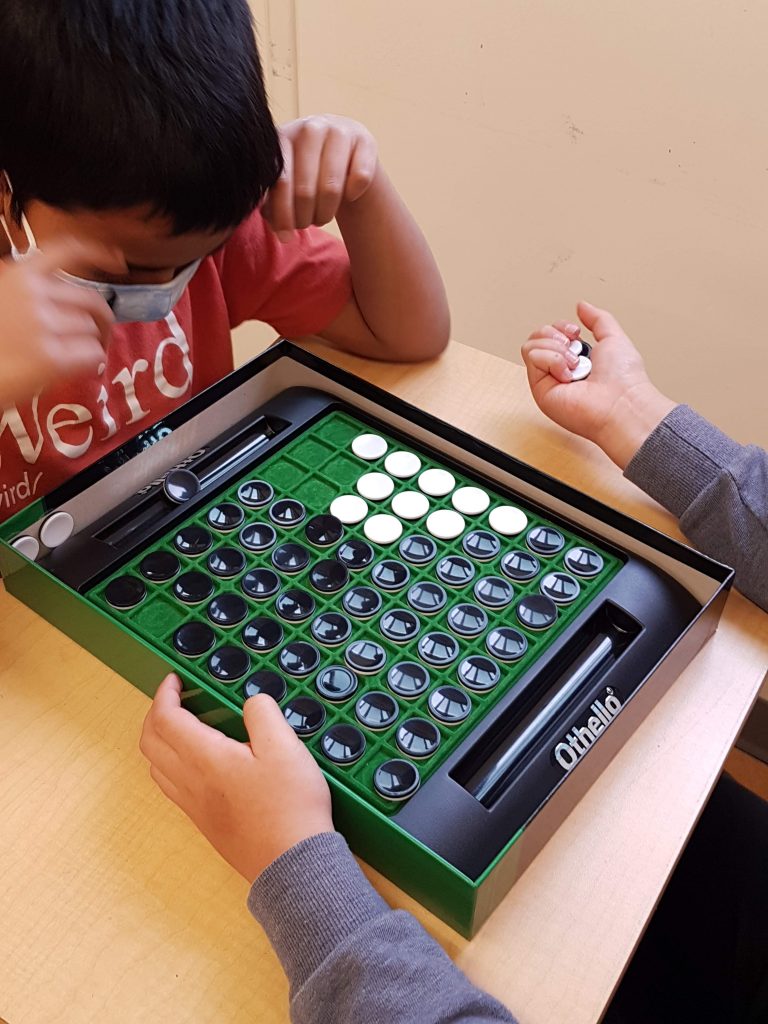
The tasks involve BRAIN CROSSING — in other words, doing traditional math, but while also playing games and analyzing them, making visual representations of math concepts, creating a math rap, answering math questions online and in a book, and more. The more we cross between subject areas and skills, the more concepts are cemented in our brains. Plus, it is hopefully more fun!
These majority of these tasks are meant to be done IN THE CLASSROOM, NOT AT HOME so I can see students working, ask them questions, and help as needed. Supplies they need are in the classroom and can’t go home, with the exception of some handouts. While some tasks and writing can be done at home, please remind students class time is being given for these activities, and I do not want them to be working past 30-40 minutes at home. It is not homework. They will need to learn to be SELF MANAGERS and use classtime well, so they can complete it with Ms. D.
There are many tasks, and students may not finish all of them — that is okay. They can choose the order and how many they are able to do. The minimum amount for PROFICIENCY is to finish 6 tasks, which are detailed on the handout.
Students have a lot of choice and can complete tasks in any order. Depending on how they feel, they can work with a partner at a large table, or choose to sit alone for a bit at a private desk. I hope it will provide everyone with the appropriate level of engagement they need to explore our math curriculum with depth and complexity. If anyone needs help with the questions, I am here to guide and to teach students one-on-one.
Websites to explain the games, as well as more complex topics, are available under “Math” in the Articles of Interest.
PLEASE: Again, unless a student is absent, or I direct everyone to do some math tasks at home, students need to be doing most of the work at school. They can take the tasks/binder/journal home, but they need to return to school each day or it will be difficult to do our activities. Thank you for your support with this.
The tasks allow us to investigate math content and curricular competencies across subject areas. For example, as they work together or alone, students will be able to:
- Practice and discuss elements of good learning and work habits
- Use critical-thinking skills to obtain information and mathematical understandings
- Exchange ideas and build shared understandings about the math content.
- Integrate language arts and math, using language in creative ways to express math understandings.
- Answer critical-thinking questions, ask questions of their own, corroborate inferences, and draw conclusions using evidence.
- Collect simple data to provide evidence about their thinking
- Use graphs and venn diagrams to make comparisons and organize the data.
- Develop mental math strategies and abilities to make sense of quantities (Magic Number activities, Sumoku game, Quirkle).
- Visualize to explore mathematical concepts (Quirkle, Blokus, Venn Diagrams)
- Use technology to explore mathematics (iPad videos, Math is Fun website, Domain of Science YouTube Channel, and more.)
- Develop, demonstrate, and apply math understandings through play, inquiry, and problem solving.
- Communicate math understandings in many ways.
- Work with addition and subtraction, multiplication and division, and multiples and factors according to their abilities and grade level.
- Explore patterns found in numbers and how they can be represented both visually and numerically.
- Investigate number concepts such as types of numbers (irrational, rational, integers, etc.), number lines, prime and composite numbers, and more.
Enjoy our math tasks!
Ms. D